Key takeaways
- Immediate risk control and permanent correction should be recorded separately.
- Every action needs clear ownership
- evidence and authorised verification.
A warehouse corrective action is a documented response to a defect, hazard or control failure that requires more than recording the observation. It identifies what must change, who owns the work, how people are protected in the meantime, what evidence will support closure and who verifies that the result is acceptable.
The aim is not to close tickets quickly. It is to restore and demonstrate effective control of risk.
Where does corrective action fit in WHS risk management?
Quick answer: Corrective action sits between identifying a problem and reviewing whether the response works. It should preserve the risk decision, action and evidence needed to show that the control was implemented and reviewed.
Safe Work Australia's model risk-management code describes a cycle of identifying hazards, assessing risks where required, controlling risks and reviewing controls. A corrective-action workflow should support that cycle rather than operate as a detached maintenance list.
The distinction matters:
- Finding: a damaged racking upright is observed.
- Immediate control: the affected location is isolated or unloaded under the site's risk process.
- Assessment: an authorised competent person determines the required response.
- Corrective action: approved repair or replacement is assigned and completed.
- Verification: evidence is reviewed before the area returns to normal use.
- Review: repeat impacts may trigger traffic, layout or protection changes.
What should a corrective-action record contain?
Quick answer: A record should make the decision trail understandable to a person who was not present. At minimum, retain context, the finding, interim control, owner, target, evidence and verification.
1. Context
Identify the site, asset, aisle or work area, source inspection and applicable procedure. "Fix rack" is not enough to find or evaluate the risk later.
2. Clear finding
Describe what was observed without guessing at technical conclusions. Attach useful photographs, measurements or documents and preserve the original observation.
3. Immediate control
Record what was done before the permanent response: removing a forklift from service, isolating a rack bay, stopping a task or restricting access. Immediate control is not the same as final closure.
4. Owner and accountable role
Assign the action to a named person with authority to coordinate it. Also identify who owns the operational risk if that is a different role.
5. Risk-informed target and escalation
Set the response target through the organisation's risk process and applicable technical advice. Avoid copying universal 24-hour, seven-day or 30-day rules onto every finding. The appropriate response depends on the hazard, exposure, controls and source requirements.
6. Defined closure evidence
State what will demonstrate completion before work begins. This might include a technician's service record, replacement part evidence, photographs, an updated drawing or a competent-person assessment.
7. Independent verification where appropriate
Verification asks whether the action produced an acceptable result. The required verifier depends on the risk and technical issue; it may be a supervisor, maintenance lead, supplier, competent inspector or engineer.
Three ways warehouse actions disappear
Verbal escalation
An operator tells a supervisor about a brake issue. The message is reasonable, but there is no stable owner, status or return-to-service decision. The inspection and maintenance response become separate stories.
A second system with no connection
The failed inspection is stored in one tool and the repair in another. Neither record carries the other's identifier, so the organisation cannot prove that the specific finding was resolved.
Closure without verification
An action is marked complete because work was scheduled or a comment says "done". No evidence shows what changed, who accepted it or whether the control is now effective.
Worked example: forklift brake fault
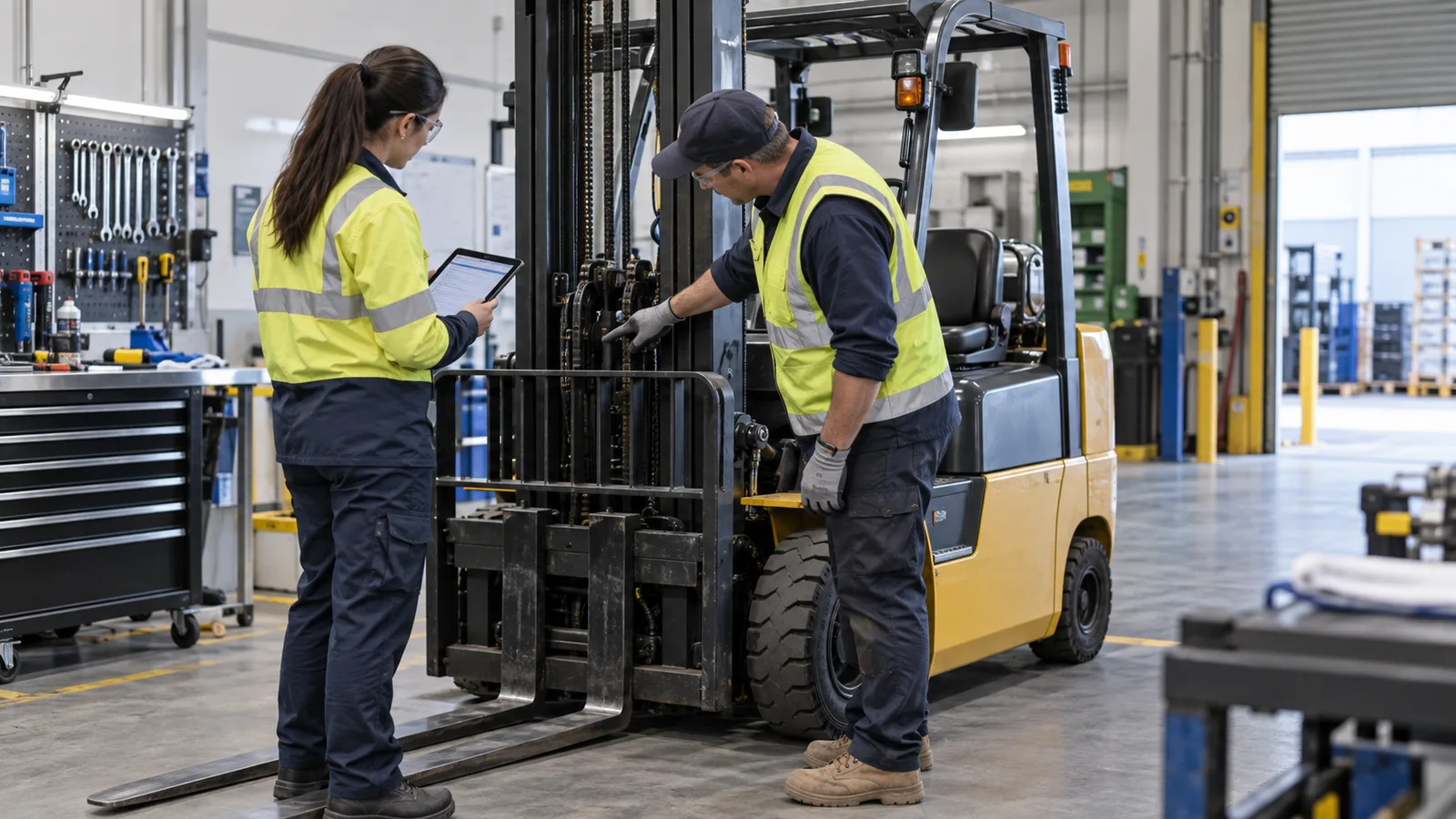
WorkSafe Victoria says forklift pre-operation inspections should follow manufacturer recommendations and defects must be reported. It also calls for a system to lock out a forklift that is unsafe for use and for records of defects, rectification and pending follow-up.
A defensible workflow is:
- The operator records the failed brake check against the specific forklift.
- The unit is removed from service under the site's lockout process.
- A responsible owner receives the action and supporting evidence.
- A suitably competent technician inspects and completes the required work.
- The service record is attached to the original action.
- An authorised person verifies the required checks before return to service.
- Repeat brake findings trigger review of maintenance intervals, operating conditions or use.
The system should not decide the repair. It should ensure the people who can decide have the finding, context and evidence.
Worked example: damaged pallet racking
SafeWork NSW says racking damage should be reported immediately so it can be inspected and assessed. Its guidance also says modifications should be approved by the manufacturer, supplier or a qualified engineer with relevant experience.
The record should identify the exact aisle, bay and component; capture the immediate control; retain the competent assessment; link approved repair or replacement; and record verification before normal use resumes. A generic colour label by itself is not the evidence trail.
How should corrective actions be prioritised?
Quick answer: Prioritisation should reflect credible consequence, exposure, effectiveness of interim controls and technical advice. It should not be based only on how long a ticket has been open.
Use a consistent decision model:
- What harm could occur and how severe could it be?
- Is anyone currently exposed?
- Has the hazard been isolated or otherwise controlled?
- Is the condition stable or likely to deteriorate?
- Does the manufacturer, regulator or competent assessor require a specific response?
- Is the finding repeated or present at other sites?
Escalation should make unresolved risk more visible as its control weakens or target is missed. It should not encourage premature closure just to protect a metric.
Which measures are useful to executives?
Quick answer: Use a balanced group of leading measures that show exposure, response quality and recurrence. Do not reduce the programme to total actions closed.
Useful measures include:
- open actions by risk and effectiveness of interim control
- overdue actions by accountable owner and site
- time from finding to immediate control
- time from action completion to verification
- actions reopened after failed verification
- recurring findings by asset, location or cause
- findings that reveal the same control gap across sites
- percentage of closures with the required evidence.
Safety research describes inspections, safety correction and audits as possible leading indicators, while warning that indicators are contextual. A 2024 Safety Science review found considerable variation in how leading indicators are defined and used. The sensible conclusion is to use a small set tied to the organisation's risk process, not a universal dashboard copied from another industry.
What good close-out looks like
A strong close-out answers five questions:
- Was the required work actually completed?
- Is the evidence sufficient for the type of risk?
- Did an authorised person verify the result?
- Were affected procedures, drawings, signs or training updated?
- Does the finding reveal a wider or recurring control problem?
Auditly keeps the original inspection, corrective action, ownership, due date, attachments and closure decision connected in one operational trail. It does not make engineering or legal decisions, and it should not be configured to treat a checkbox as technical verification.
Sources
- Safe Work Australia: Model Code of Practice - How to manage work health and safety risks
- WorkSafe Victoria: Forklift maintenance and inspection
- SafeWork NSW: Pallet racking fact sheet
- Bayramova et al.: Unravelling the Gordian knot of leading indicators
- Wurzelbacher et al.: Constructs of leading indicators
This article provides general information, not legal, engineering or maintenance advice. The responsible person should apply the relevant jurisdiction, manufacturer instructions and competent technical advice.
Next step
Make inspection follow-up easier to prove
Standardise checks, assign corrective actions, and keep closure evidence connected to the original finding.
General operational guidance only. Confirm current requirements with the relevant regulator, applicable standards, and qualified advisers.